What to Expect from Everyday Wardrobe Basics
Choose an everyday basic by considering three separate questions: does it fit the way you want, does it feel agreeable during your usual activities, and what evidence supports your expectations of its performance? Treat these as a practical decision framework, rather than assuming that one positive answer settles all three.
For this guide, fit means the shape, coverage and freedom of movement you want. Feel means your own response to the garment while wearing it, including contact at necklines, seams and waistbands. Performance means what you expect over repeated use, such as retaining an acceptable appearance after wear and care. A brief fitting is an opportunity to assess the first two; leave longer-term expectations open unless relevant evidence supports them.
The checks below cover T-shirts, shirts, knitwear, trousers and simple dresses. They are editorial suggestions for assessing your own preferences, not findings from garment testing.
The supplied ARKET EU bathroom-page excerpt includes navigation to women's clothing categories. It contains no garment specifications, sizing guidance, performance evidence or care instructions. Consequently, this guide makes no claims about how ARKET clothing fits, feels or lasts. Use the exact garment's official information whenever a decision depends on those details.
Check Fit across Tops, Knitwear, Trousers and Dresses
AI-generated generic editorial illustration — not a retailer product photo and does not depict the reviewed product or service. Make the editorial try-on checklist easy to follow without implying verified ARKET sizing or product performance.
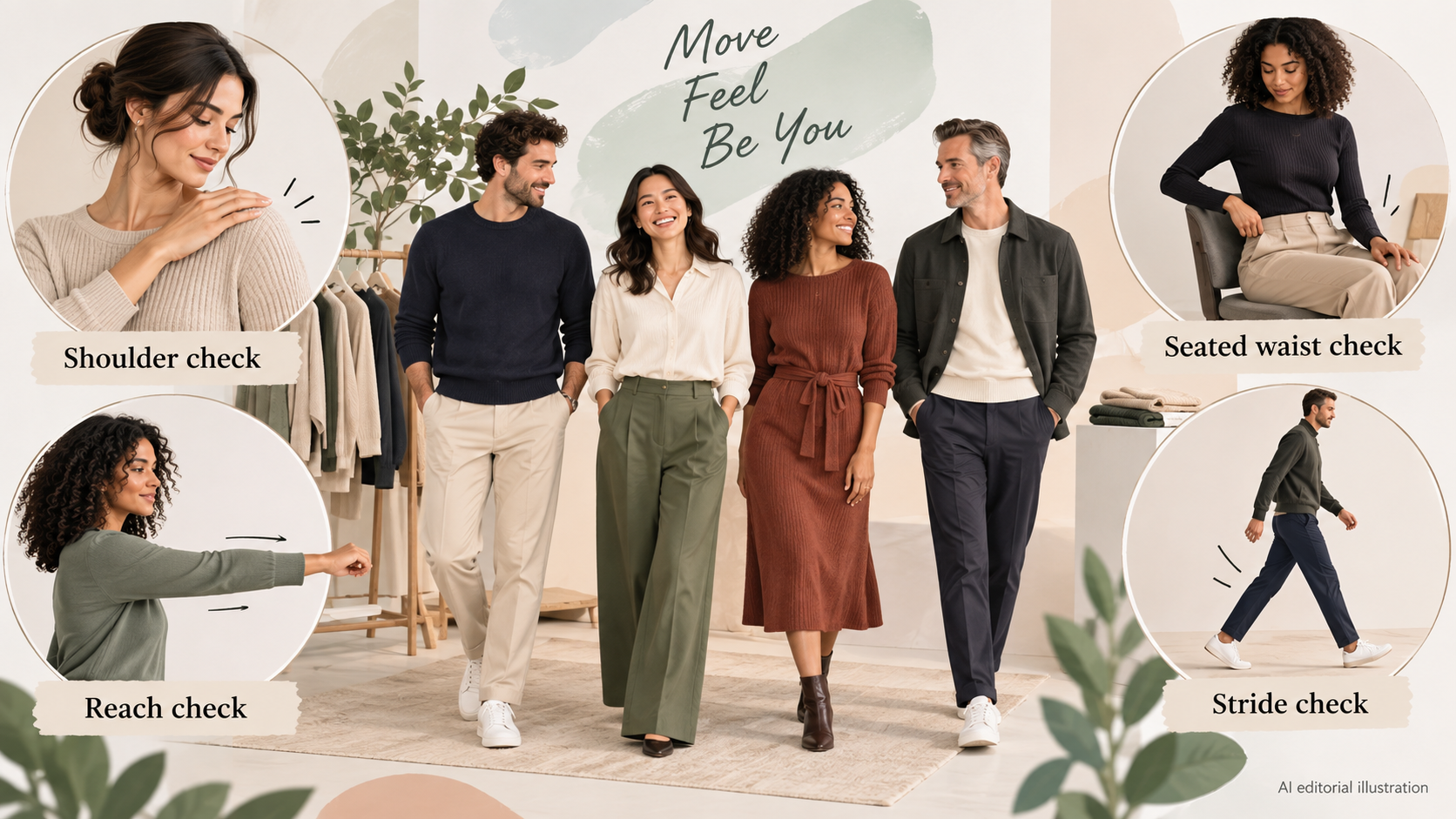 Start with a specific use: a T-shirt for wearing alone, a shirt for desk work, or trousers for a day involving both walking and sitting. Try the garment with the underwear, layers and footwear you expect to use. Assess whether it works in that combination before judging it as a standalone purchase.
For T-shirts and shirts, inspect the neckline, shoulder placement and sleeve opening. Decide whether their positions match your preferred silhouette; do not assume every shoulder seam should sit at the same point. Reach forward, lift your arms comfortably and sit down. Notice any pulling, unwanted exposure or need to rearrange the hem. With a buttoned shirt, check the front while seated as well as standing, and decide whether any opening between buttons is acceptable to you.
For knitwear, repeat those movements over your intended base layer. Check whether you like the space through the upper arms and body, and whether cuffs and neckline feel agreeable. Try the hem both as you would normally wear it and beneath any intended outer layer. Avoid relying on an assumption that an uncomfortable area will loosen later.
For trousers, fasten the waistband where you intend it to sit, then sit naturally and take several normal steps. Assess pressure at the waist, room through the seat and thighs, and pocket openings. Check the hem with your usual shoes. Choose based on the position and movement you want, rather than a universal rule about how close trousers should sit.
For dresses, check the neckline, armholes and waist position, then sit and walk. Take a comfortable longer step if space permits. Consider whether the skirt allows your intended stride and whether the coverage remains acceptable when seated.
Use this compact checklist during a fitting:
| Garment | Movement check | Personal decision |
|---|---|---|
| T-shirt or shirt | Reach forward and raise arms | Is the pull and coverage acceptable? |
| Knitwear | Move over the intended base layer | Is the room and contact comfortable? |
| Trousers | Sit naturally, then walk | Does the waistband and leg shape suit you? |
| Dress | Sit and take a longer step | Do coverage and stride meet your needs? |
Repeat any doubtful movement once, without adjusting the garment first, to assess whether the result suits you.
Recognise the Strengths That Matter in Daily Wear
Define a useful basic through the job you want it to do. Before looking at colours or styling images, write down two or three priorities: comfortable sitting, coverage when reaching, or compatibility with a jacket you already own. Use those priorities to keep your assessment specific.
For a desk-day top, focus your fitting on seated comfort, sleeve movement and the neckline position you prefer. For a layering piece, assess it beneath the actual cardigan or jacket when possible. For trousers intended for commuting, include walking and sitting in your checks. These are suggested evaluation tasks, not predictions about a particular garment's suitability.
Inspect appearance under conditions relevant to your plans. If coverage matters, look at the garment over your intended underwear in available light, while recognising that you have only checked those conditions. If you prefer a tucked top, try the tuck and move around. If you dislike frequent adjustment, pay attention to how often you feel the urge to reposition it during the fitting.
Give wardrobe compatibility a concrete test: identify two outfits you would willingly wear with the item. Include shoes and outerwear where relevant. Do not count a combination that depends on several unplanned purchases unless you have deliberately budgeted for them.
Record the result in plain language: “comfortable seated”, “works under my jacket”, or “requires repeated neckline adjustment”. Keep observations limited to what you actually checked. Avoid turning a pleasing first impression into a claim of all-day comfort or dependable long-term wear.
Understand Fabric and Performance Limitations
Separate information you have read from observations you have made and questions that remain unanswered. An official description may provide composition or construction details; your fitting provides a personal response to that particular garment. Neither should be stretched into a conclusion beyond what it establishes.
When composition information is available, record it accurately for the exact item. Do not use a fibre name alone as proof that the garment will feel comfortable to you, retain its shape or meet your expectations over time. This guide has no admitted garment-level evidence supporting comparisons between fibres or predictions about their performance.
During a fitting, examine the surface, seams, fastenings and any lining you can access without damaging the item. Note what you see and feel: an uneven seam, a fastening that is difficult for you to operate, or contact you find irritating. These observations can inform your purchase decision without becoming a general judgement about the brand or an explanation of how the garment was manufactured.
Treat future pilling, shrinkage, colour retention and shape retention as unverified here. Do not infer them from price, apparent thickness, softness or a short period of handling. If one of these questions determines whether you would buy, seek relevant official information for the item and check precisely what it says.
You can still make a decision with uncertainty. Set a threshold in advance: which features must be established, and which unanswered questions are you willing to accept? If an essential requirement remains unsupported, leave the purchase undecided rather than filling the gap with a favourable assumption.
Match Care Requirements to Your Routine
AI-generated generic editorial illustration — not a retailer product photo and does not depict the reviewed product or service. Help readers assess maintenance effort while keeping all garment-specific instructions dependent on verified care information.
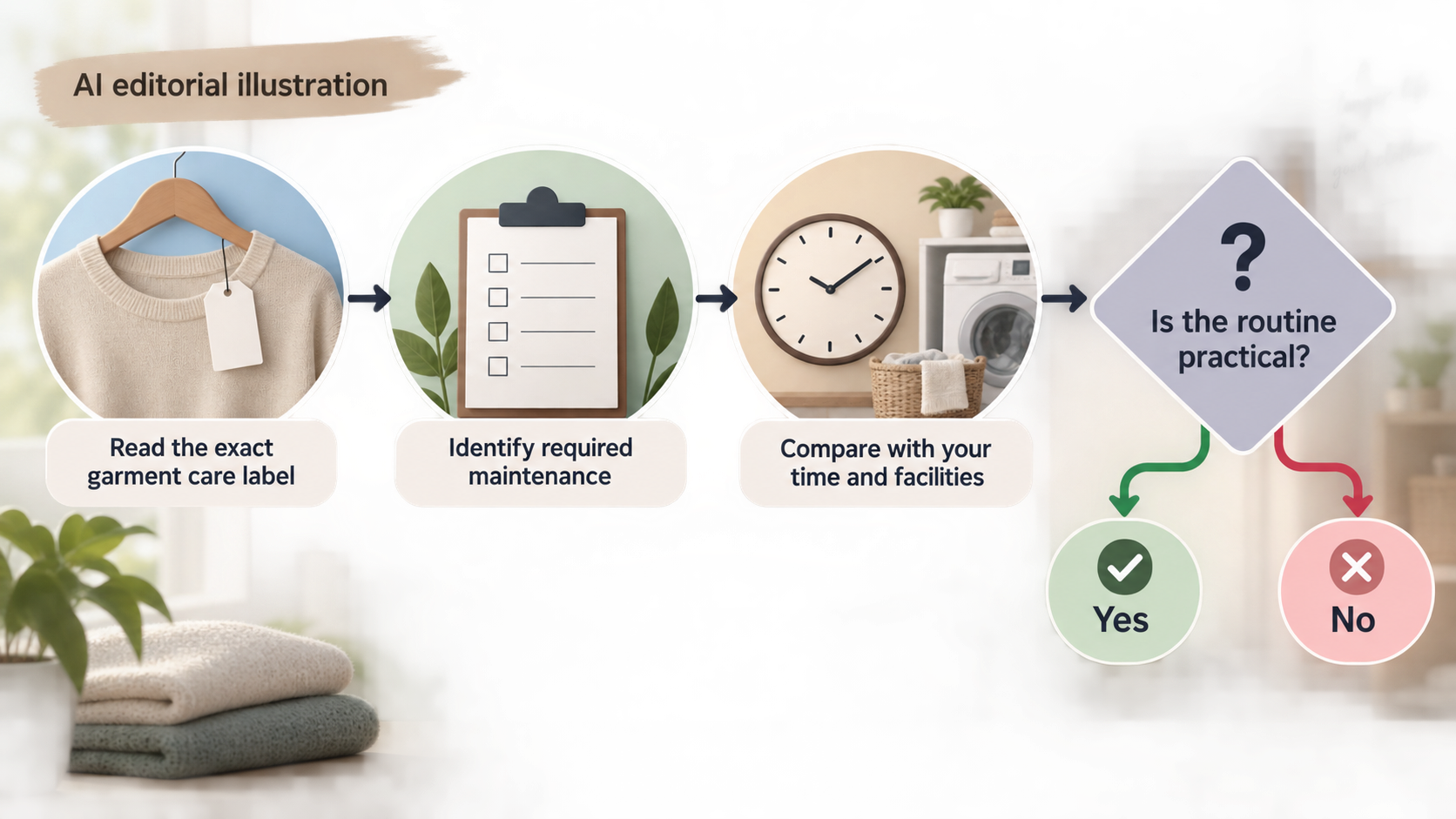 Before buying, read the exact garment's care information. If it is missing or unclear online, seek clarification from the retailer before committing when maintenance is central to your decision. After receiving an item, consult its label before washing or treating it. This guide does not supply garment-specific washing, drying or ironing instructions.
Make your own routine explicit. Consider the facilities you have, the time you are willing to spend, and where you would carry out any required drying or storage. Assess the stated process against an ordinary busy week, rather than the most organised version of your schedule.
Use this care-label-first decision guide:
| Step | What to establish | Next decision |
|---|---|---|
| Read | The exact item's stated care requirements | If unclear, seek an authoritative explanation |
| Identify | The tasks, facilities and time those requirements involve | List what you would need to provide |
| Compare | Whether your usual routine accommodates them | Identify any practical mismatch |
| Decide | Whether you are willing to maintain that routine | Buy, reconsider or leave the choice open |
Do not substitute a general laundry habit for an instruction you have not checked. Where a symbol needs interpretation, consult an authoritative care-label reference rather than guessing from its appearance.
Keep care decisions separate from assumptions about returns. Before removing tags, laundering or wearing an item beyond a fitting, verify the retailer's applicable return conditions. No return terms are established by the supplied excerpt. If the maintenance required is more than you want to undertake, treat that as a valid reason to reconsider the garment, even when its initial fit appeals to you.
Verify Sizing and Market Details Before Ordering
For a UK order, first establish which regional storefront you are using and whether its information applies to your delivery address. The supplied ARKET URL is an EU-market bathroom page. Its clothing navigation does not establish UK clothing specifications, stock availability, delivery charges or return conditions.
Use the exact retailer's measurement instructions when taking your measurements. Check whether a chart refers to body measurements or finished garment measurements, and confirm the units before comparing figures. If the distinction is unclear, request clarification. Avoid treating a familiar size label as sufficient evidence of fit across retailers or regional storefronts.
Where item-specific measurements are provided, compare relevant dimensions with a garment you already like, using a consistent measurement method. Keep the comparison focused: a similar width alone should not settle your judgement about length, silhouette or movement. No numerical size recommendation is supported by the evidence available for this guide.
Before paying, verify current UK-facing official information for the exact item and order: available sizes, delivery eligibility and charges, any stated additional costs, return deadlines, return costs and item-condition requirements. Check the selected country and currency again at checkout. If policy wording leaves an important question unanswered, obtain clarification before relying on an assumption.
Before you order, use the fit and care checklist to identify any unanswered essentials.
Frequently Asked Questions
How do I tell whether a basic is intentionally relaxed or simply too large?
Start with the exact product's official fit description, if available, then judge whether the result suits your intended use. A relaxed description need not determine your personal preference. Check shoulder placement, sleeve length, coverage and movement together. Try sitting and reaching without repeatedly adjusting the garment. If a neighbouring size is available, compare the same movements in both. Choose the silhouette you prefer only after checking that its practical details work for you; this guide cannot verify the intended fit of any specific product.
What should I check when I fall between two sizes?
Confirm the measurement method, units and whether the chart describes bodies or garments. Identify the areas most important for your use, such as seated waist comfort or room for a base layer. Consult any item-specific official fit information before deciding. If trying both sizes is practical, first verify the applicable delivery and return costs and conditions. Avoid a blanket rule to always size up or down; assess each option against the same fit checklist.
Can fibre composition alone tell me whether a garment will feel comfortable?
Do not treat composition alone as a personal comfort verdict. Use it as one piece of the exact item's information, alongside your own assessment where a fitting is possible. Pay attention to contact at seams, neckline, sleeves and waistband, and try the layers you intend to wear. The supplied evidence does not support fibre-based comfort rankings. If you cannot try the garment, keep comfort uncertain and check the applicable return conditions before ordering.
Should I keep a basic if its care instructions do not suit my routine?
Reconsider it before washing or wearing it further. Read the exact instructions again and identify the mismatch: facilities, time, drying space or effort. Seek clarification if the instructions are unclear, but do not assume you can safely replace them with your preferred routine. If you are unwilling to provide the required care, check whether a return is available under the current applicable conditions. A pleasing fitting does not oblige you to accept a maintenance commitment you do not want.
Sources
Related reading
- When to buy women's everyday wardrobe basics for better value
- How to identify genuine women's everyday wardrobe basics deals
- Best women's everyday wardrobe basics: evidence-led top choices
- UNIQLO vs COS: which is the better fit
Editorial information: About our editorial team · Read our editorial policy · Read our affiliate disclosure.