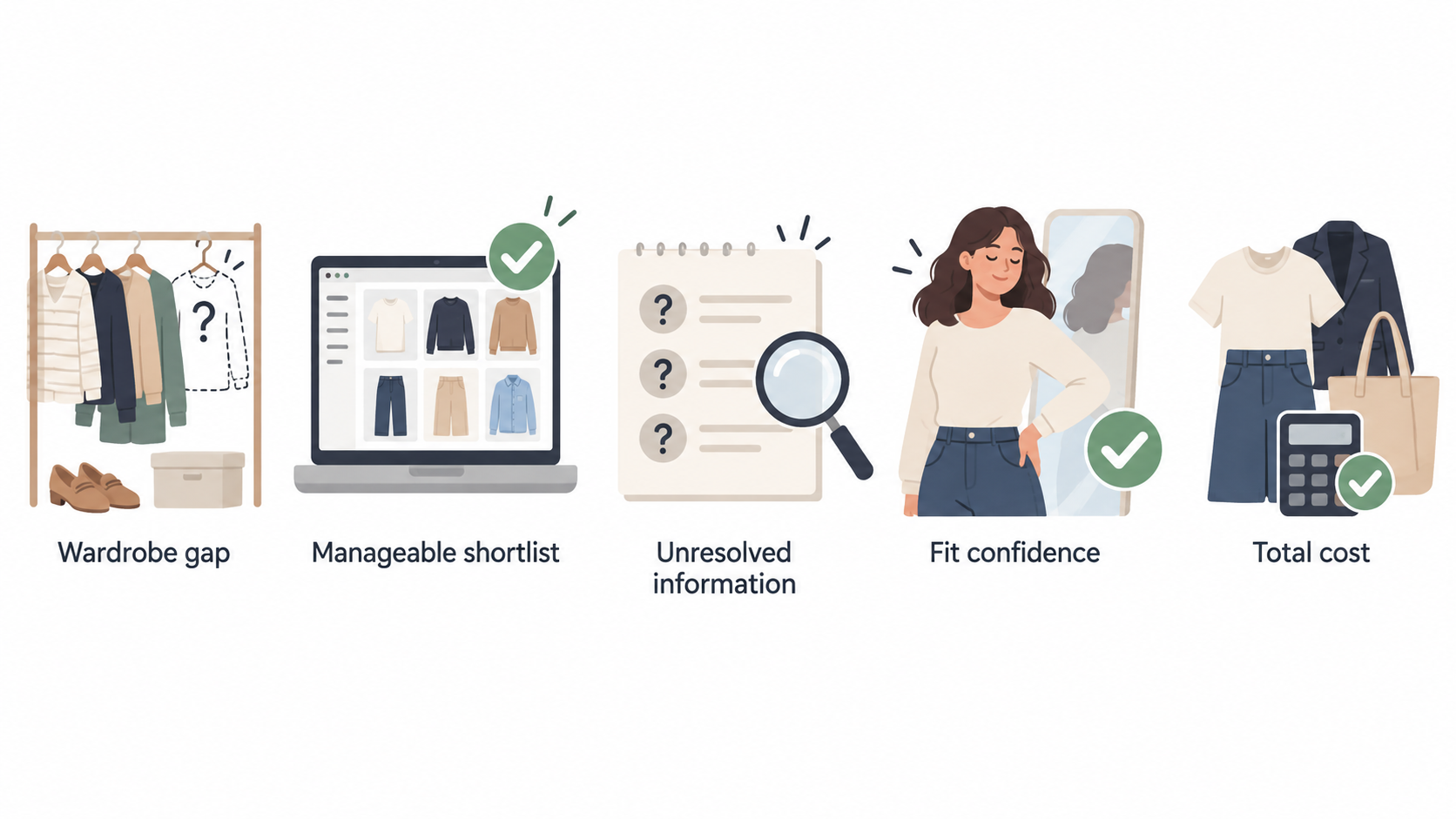
AI-generated illustration — not a retailer product photo.
Start with wardrobe needs and a realistic budget
AI-generated illustration — not a retailer product photo.
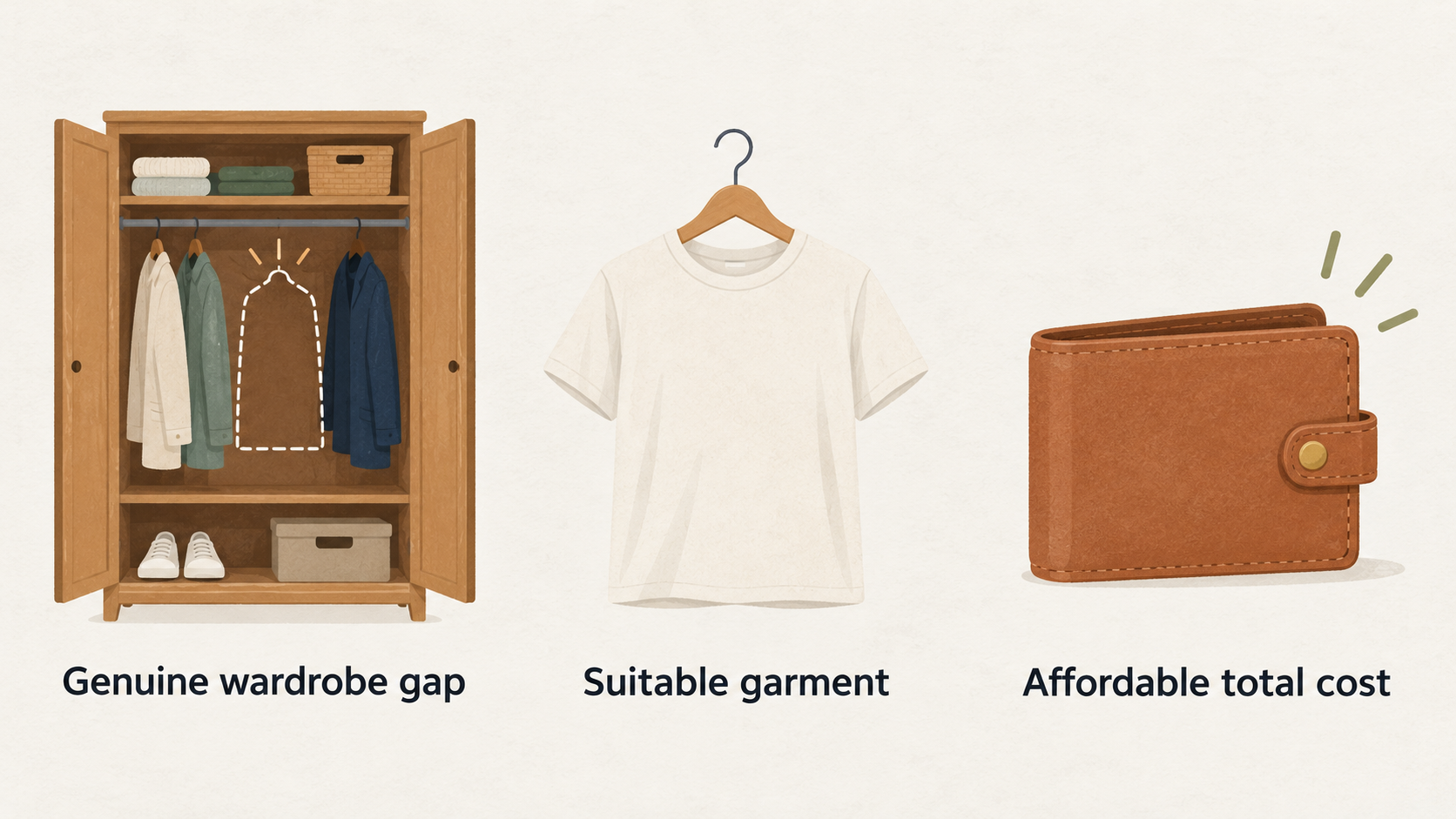
Buy when a genuine wardrobe gap, a suitable garment and an affordable total cost line up. Wait when the purchase is optional, the price exceeds your limit or important details remain unclear. That approach gives you a reason for choosing a purchase date without needing to predict the next sale.
Start with the job the item must do. Perhaps you need a T-shirt for regular layering, trousers for work or a jumper to replace one you can no longer wear. Write that need in one sentence, then check whether something you already own can cover it. An existing substitute gives you more freedom to wait.
Next, set a spending ceiling before browsing. Use the amount you can comfortably spend on the whole purchase, including any delivery or other applicable charges. Keep this separate from the retailer's advertised reduction: your budget should not increase simply because a larger discount appears.
For this guide, better value means a purchase that fits its intended use and your budget, with enough information to judge suitability. The retailer excerpts provide useful category and merchandising context. They do not establish the cheapest shopping month, measured garment durability or a guaranteed saving from waiting.
A useful starting note is: “I need this item for these outfits, by this date, and my maximum total spend is this amount.” Use it to keep the decision focused.
Use category and material information to build a shortlist
AI-generated illustration — not a retailer product photo.
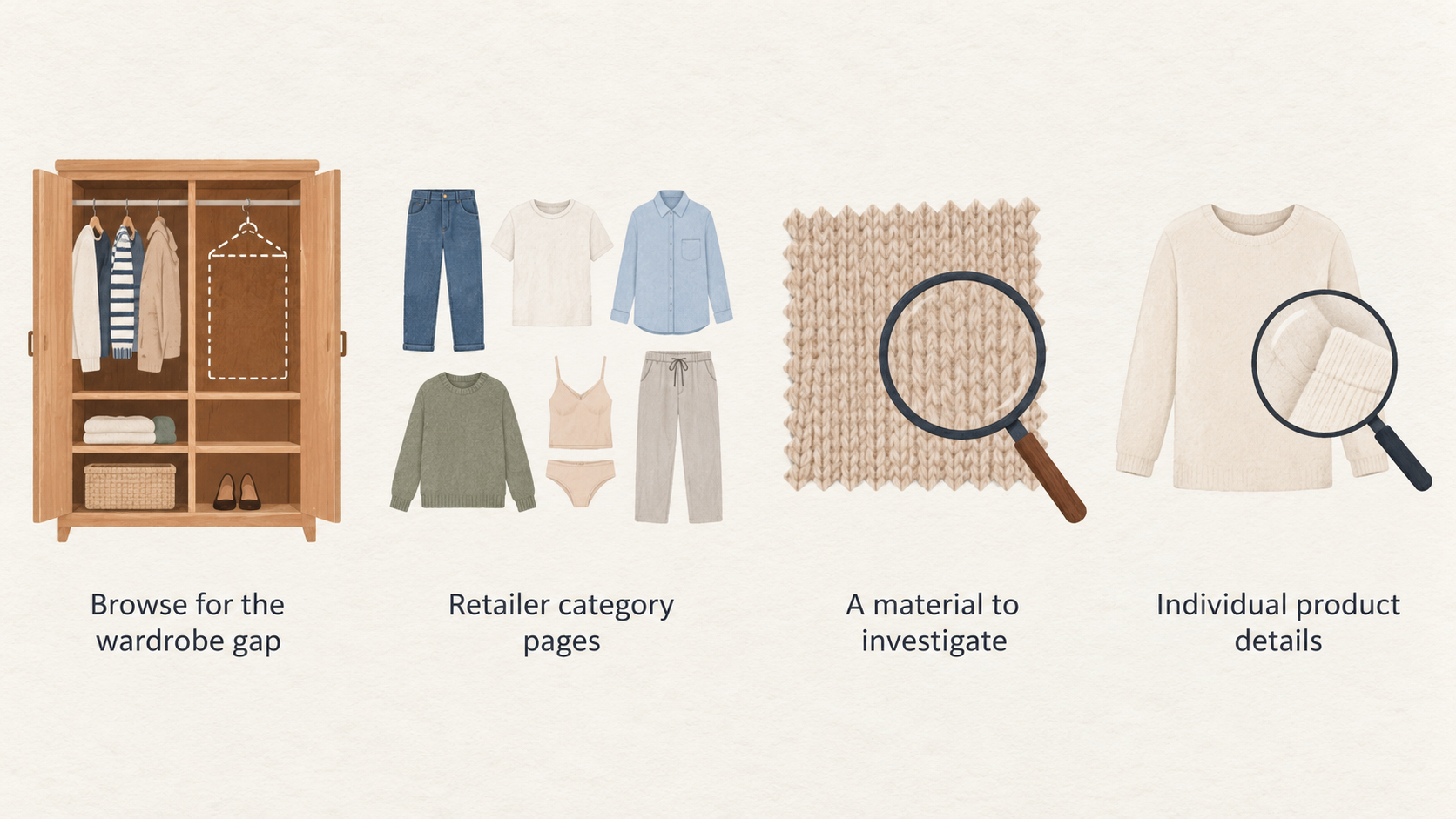
Retailer category pages can help you turn a broad intention to buy basics into a manageable shortlist. Browse for the wardrobe gap you have identified, then move to individual product details before deciding whether anything deserves a place on it.
The supplied UNIQLO UK excerpt lists categories including jeans, T-shirts, shirts and blouses, knitwear, innerwear and loungewear. Its knitwear description names pure cashmere, Merino and lambswool options. These are useful starting points for finding a type of garment or a material to investigate; the excerpt does not establish the composition of every product within those categories. UNIQLO UK
Everlane's supplied women's page includes tees, tops, sweaters and denim. It also presents its clothing through statements about responsible production, considered craftsmanship and lasting use. Those are the retailer's descriptions of its offering, rather than independently demonstrated findings about how a particular garment performs. Everlane women's collection
Keep the shortlist small enough to compare properly. For each candidate, record its intended role, the size you would investigate and the product information you still need. For a jumper, that might mean composition and care requirements; for jeans, it might mean garment measurements and the cut you want.
Treat material names as prompts for questions. Does the specific composition suit your preferences? Are you willing to follow the care instructions? Does the shape work with clothes you already own? Category breadth and appealing brand language can help you discover candidates, but neither establishes superior value or garment performance.
Check the gaps before trusting a value claim
Before judging a purchase good value, identify what the available information leaves unresolved. Neither supplied excerpt provides a product-level comparison covering prices, historical prices, garment measurements, care instructions and current return terms. Without those details, there is no sound basis here for ranking individual garments by savings or suitability. UNIQLO UK, Everlane women's collection
Everlane uses general messaging about better prices alongside references to the same quality and styles. The excerpt does not attach that message to a specified product, previous price, reduction amount or applicable UK promotion. It therefore cannot substantiate a percentage saving or show that a UK shopper would pay less overall. Everlane women's collection
There is also a market distinction. The UNIQLO source is explicitly a UK page. The supplied Everlane page does not establish delivery availability to your UK address, delivery charges, duties or return arrangements. That is an information gap to investigate, rather than evidence that any particular charge or restriction applies. UNIQLO UK, Everlane women's collection
Apply the same care to sustainability and longevity statements. Everlane says its materials, factories and certifications are verified, traceable and supported by third parties. The supplied excerpt contains that assertion, but not the underlying documentation needed to assess its scope for an individual garment. Everlane women's collection
For your own comparison, mark missing details as “unknown”. Do not fill them with assumptions about a familiar brand, a premium material or an attractive photograph. If an unknown could change affordability, fit or your ability to return the item, resolve it before buying.
Decide when to buy now and when to wait
AI-generated generic editorial illustration — not a retailer product photo and does not depict the reviewed product or service. Make the buying-timing framework easy to apply while distinguishing immediate needs, optional purchases and decisions requiring further verification.
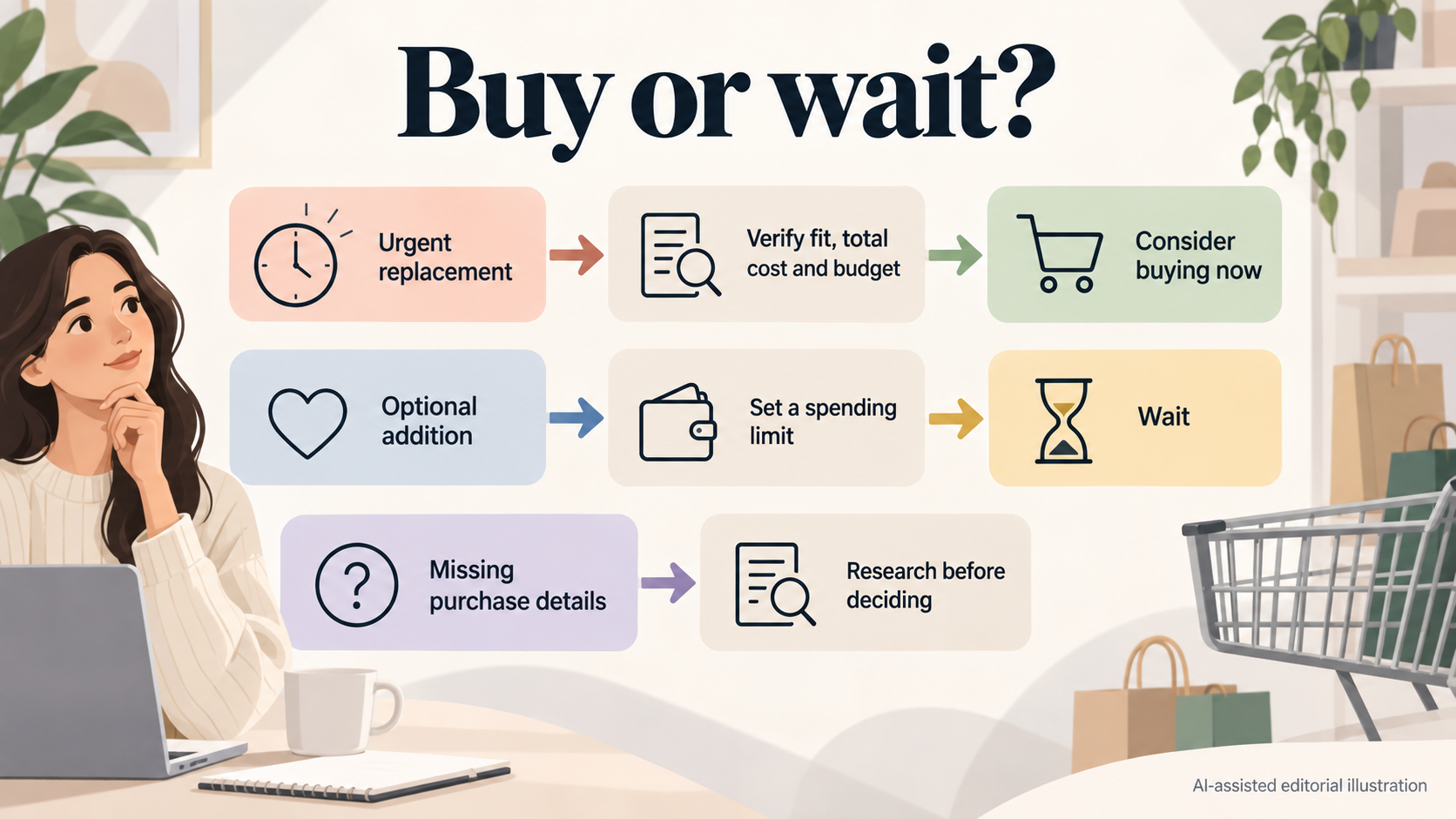 Use urgency, an existing substitute, fit confidence and a personal target price to decide your next step. The target price should be an amount you are willing to pay, rather than a prediction of what a retailer will charge later.
Consider buying now for a necessary replacement. If you need an item soon and have no workable substitute, first check whether the candidate meets the practical brief. Confirm the relevant measurements, composition, care requirements, total cost and return terms. If those details are satisfactory and the purchase fits your budget, buying now can be a reasonable decision even without a verified discount.
Urgency should set your research deadline, not remove the research. If you cannot establish fit or affordability, look for another candidate with clearer information rather than treating the first option as inevitable.
Wait for an optional addition. If your existing wardrobe already covers the need, save the item and record the price you actually see. Set a maximum total spend and a review date. Waiting gives you time to reconsider how much you want it; it does not guarantee a markdown or continued availability.
Research before deciding when important details are missing. Unclear measurements, return conditions or UK fulfilment costs can prevent a useful comparison. In this situation, your next action is to obtain the missing information. A lower displayed price would not resolve those uncertainties.
The supplied pages feature seasonal merchandising: Everlane introduces Fall 2026, while UNIQLO describes Autumn/Winter 2026 collections and autumn arrivals. Those messages show how the retailers present their ranges. They do not establish when those products will be reduced. Everlane women's collection, UNIQLO UK
Nothing in the supplied evidence supports recommending Black Friday, January or an end-of-season period as a reliably cheaper time to buy these basics. Keep your timing tied to your circumstances and verified purchase details.
A compact decision sequence is: urgent replacement → verify suitability and total cost → consider buying within budget; optional addition → set a limit and wait; missing details → research before deciding.
Compare total cost before acting on a discount
Compare the amount you would actually pay for a suitable item, using the same basis for each candidate. A headline reduction is only one part of that exercise.
Start with the price of the exact product, colour and size you intend to order. Add delivery and any other applicable charges that you have verified. For an overseas purchase, investigate whether currency conversion charges, taxes or duties affect your payment, and whether the quoted total includes them. Leave any unresolved amount visibly unknown instead of assuming it is zero.
Record return costs separately as a possible expense if the item proves unsuitable. Check any conditions that could change your decision, such as the deadline, the required item condition or restrictions applying to the exact purchase. Do not assume terms from another retailer or an earlier order still apply.
A simple comparison note can contain:
- The exact item and the date checked.
- The displayed price and currency.
- Verified delivery and other applicable charges.
- The confirmed total payable, or the amounts still unknown.
- Return conditions and any verified return cost.
- Your spending ceiling and intended use.
If you track prices over time, compare the same item and variant wherever possible. A different garment, pack size or composition may not provide a like-for-like benchmark. Your own dated observations can show what you saw, but a short record should not be described as proof of a retailer's lowest-ever price.
Finally, check the basket against your original need. If you add an unwanted item to meet an offer threshold, compare the resulting total with buying only what you intended. Judge the decision by the money leaving your budget and the usefulness of the purchase.
Run a final check before checkout
Immediately before ordering, return to the current product and policy pages. The supplied collection excerpts are browsing context, so use fresh purchase details for the final decision.
Work through these checks in order:
- Need: State what the garment replaces or which gap it fills. Identify the outfits you expect to wear it with.
- Fit: Check the relevant size information and available garment measurements against your requirements. Resolve any uncertainty that would make ordering unacceptable to you.
- Composition and care: Read the exact product's fabric content and care instructions. Make sure the required upkeep is something you are willing to do.
- Total cost: Confirm the selected variant, currency, delivery and any other applicable charges against your budget.
- Returns: Read the current terms for your location and purchase, including deadlines, exclusions and any return cost.
For Everlane, investigate unresolved UK delivery and return details before proceeding: the supplied excerpt does not establish them. Everlane women's collection
Keep announcements separate from offers you can actually use. UNIQLO's excerpt mentions a Cambridge Grand Arcade opening on 24 September and opening-day offers, but gives no product-level offer terms. That does not establish a generally available discount for your basket. UNIQLO UK
Once these checks are complete, make the decision against your original spending ceiling. If a material detail remains unknown, keep the item on your research list.
Frequently Asked Questions
Is there a reliably cheapest month to buy women's wardrobe basics?
The supplied evidence does not establish one. Both retailers use autumn collection messaging, but neither excerpt provides the price history or sale timetable needed to identify a reliably cheapest month. Everlane women's collection, UNIQLO UK
For an optional purchase, record the exact item's observed price, choose your spending limit and review it later. Treat any future discount as uncertain. This gives you a practical waiting strategy without assuming that a particular shopping event will deliver a better price.
Should I wait for a sale to replace an everyday item I need now?
Consider buying now if you have no workable substitute, have checked suitability and can afford the verified total cost. You do not need to wait indefinitely for an unconfirmed reduction.
If something you already own can cover the gap, waiting remains an option. Set a review date based on when the replacement becomes necessary. Avoid letting urgency push you into buying an item whose fit, care requirements or purchase terms you have not checked.
How can I compare an overseas offer with a UK price?
Compare the total payable on a consistent currency basis, then examine the return arrangements separately. Verify delivery and any applicable conversion charges, taxes or duties, including whether they are already included in the quoted amount.
The supplied UNIQLO page is UK-specific, while the Everlane excerpt does not establish UK fulfilment costs or return terms. Resolve those gaps before treating an Everlane displayed price as directly comparable with a UK purchase. UNIQLO UK, Everlane women's collection
Does a lower cost per wear estimate justify spending more upfront?
Use estimated cost per wear as a planning aid, not a promise. Divide the purchase cost by a plausible number of wears, and label that number as an assumption. If you include expected care costs, use the same approach for every candidate.
Try a lower-wear scenario as well. An estimate depends on future use and does not demonstrate durability. If the purchase only looks affordable under an optimistic assumption, reconsider it. A favourable projection should not override your spending ceiling, fit concerns or uncertainty about whether you will wear the item.
Related reading
- How to identify genuine women's everyday wardrobe basics deals
- Best women's everyday wardrobe basics: evidence-led top choices
- UNIQLO vs COS: which is the better fit
- UNIQLO review: strengths, limits, and alternatives
Editorial information: About our editorial team · Read our editorial policy · Read our affiliate disclosure.